
Recycling & Donation Programs for Leftover Swag
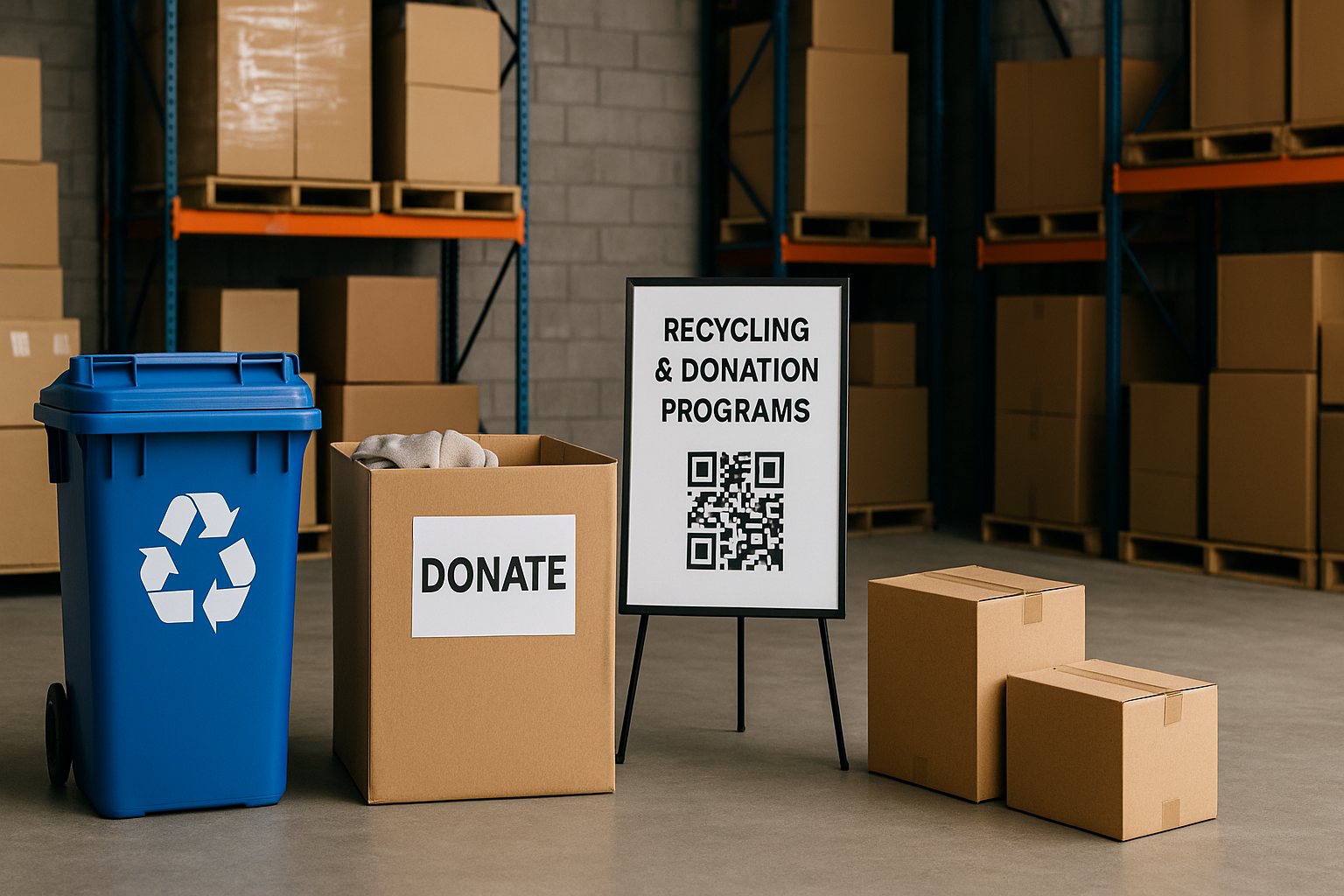
Set up clear bins and a QR-driven program to recycle or donate leftover swag—keeping usable items out of landfills and reducing post-event waste.
Leftover swag doesn’t have to become landfill. With a simple, repeatable plan, you can turn excess promotional items into community value, protect your brand, and prove sustainability outcomes after every trade show. Use this supporting guide to build a recovery workflow that fits inside teardown—without slowing your team or complicating logistics.
Why leftovers happen (and why planning beats guessing)
Even tight forecasts miss. Swings in traffic, weather, or neighboring booth activity can leave you with extra tote bags, notebooks, apparel, or drinkware. Tossing them adds transport costs, inflates your carbon footprint, and creates avoidable waste. A prewritten recovery plan changes the equation: you reuse what still fits your program, donate what’s useful to nonprofits, and recycle what’s truly end-of-life—while capturing numbers your leadership cares about.
Write a one-page recovery policy before you ship
Treat recovery like any other operational spec. In your event runbook, add a page that answers four things:
What you’ll do: reuse, donate, or recycle—defined in plain language.
Who decides: one owner who signs the final count and keeps photos/receipts.
Where it goes: warehouse for reuse, pre-vetted nonprofit partners for donations, venue streams for recycling.
How to document: a quick tally by item and a phone photo of each staged stack.
Keep it short enough that staff can follow it at 5 p.m. on teardown day.
Design for donation at the packing table
Recovery begins with how you pack. Choose paper-first packaging, cardboard outers, and minimal plastic wrap so sorting is fast and streams stay clean. Use tasteful branding—laser engraving on metal, restrained screen printing on textiles so products are viable as donations if they aren’t handed out. Label outer cartons clearly (show name, booth number, “Box X of Y,” and contact) and, if possible, pre-print small “REUSE,” “DONATE,” and “RECYCLE” stickers you can slap on boxes during teardown.
Reuse, donate, recycle: a practical sorting model
Reuse is your highest return. Keep premium stainless water bottles with replaceable lids, recycled-cotton or rPET totes, notebooks with metal pens, privacy covers, and any VIP items you can deploy at the next show. Pack them by audience (Aisle, Counter, VIP) and mark the destination (“Next: Mandalay Bay”).
Donate when an item is useful immediately. Great fits include neutral apparel, drawstring backpacks, school/office kits (notebook + pencil), sealed personal-care packs, and durable totes. Pair each box with a short letter on your letterhead stating counts and a contact name. Donations create brand goodwill and real community value without feeling like a dump of old inventory.
Recycle what’s truly end-of-life. Break down corrugate; route metals and #1/#2 plastics where available. Ask your graphics vendor about textile take-back for worn fabric skins.
Build a partner list by need category
Cities change; needs repeat. Maintain a lightweight contact list by category so you can adapt in any market:
Youth & schools: backpacks, notebooks, pens, refillable bottles.
Shelters & community services: socks, tees, tote bags, hygiene kits.
Workforce programs: portfolios, neutral apparel, office basics.
Materials recovery: corrugate, metals, eligible plastics, textile take-back.
A two-email exchange before the show—“What do you accept?” and “Where should we deliver?”—saves an hour on teardown night.
On-site choreography that fits inside teardown
An hour before close, stage three zones behind your counter: Reuse, Donate, Recycle. As staff tidy, they sort items into those zones and label cartons as they go. Take one photo per stack and a photo of each sealed box. If a partner can’t pick up the same day, schedule a morning courier to their intake door. This rhythm keeps your team moving and prevents last-minute panic that sends usable goods into mixed trash.
Decoration and product choices that extend life
Donation and reuse work best when products feel retail, not campaign-bound. Favor recycled-fiber totes, stainless or glass bottles with tight lids, notebooks on recycled paper, and simple tech accessories that don’t rely on niche ports. Keep logos small and timeless; move campaign messaging to an insert card with a QR code so you can change the story without scrapping the product.
Compliance and brand safety guardrails
A few rules protect partners and your brand:
Donate only clean, unopened items with ingredient labels where relevant.
Avoid liquids without safety seals and loose lithium batteries.
Skip loud slogans, dated campaigns, and apparel with edgy phrases; choose neutral.
For youth recipients, avoid small items for young children.
Ask for an acknowledgment email or receipt when feasible; file it with your show recap.
Measure what matters and close the loop
Add a small table to your internal recap:
Reused: item, quantity, destination (next event/warehouse), replacement value saved.
Donated: item, quantity, organization, acknowledgment received (yes/no).
Recycled: material stream and estimated weight/volume.
Two shows later, you’ll see patterns (e.g., too many XL hoodies, not enough notebooks) and tune ordering to reduce leftovers in the first place.
Example email you can copy
Subject: Donation of Unused Event Materials — [Show Name]
Hello [Org Contact],
After exhibiting at [Show], we set aside new, unused items appropriate for your programs. We can donate:
• 120 recycled-cotton tote bags
• 80 notebooks and 80 metal pens
• 60 stainless water bottles (boxed)
Boxes are labeled and ready for pickup/delivery to [address]. Please confirm a window and whether you can provide an acknowledgment for our records.
Thank you,
[Name | Company | Mobile]
Straight answers teams ask (no “FAQ,” just answers)
Will donation slow us down?
Not if you stage zones early and label as you sort. Most 10×20 booths can complete sorting and boxing in under an hour.
What if an item is branded heavily?
If the mark is tasteful, donate; if it’s loud or time-bound, reuse or recycle. A neutral paper sleeve can quickly “de-event” many promotional products.
Can we claim a tax benefit?
Many nonprofits provide acknowledgment letters. Record counts and values, then ask your finance team how to handle documentation in your jurisdiction.
How do we prevent leftovers next time?
Use daily release limits, track by SKU, and compare “brought vs. distributed vs. donated.” Tight feedback shrinks over-ordering without starving the booth.
The takeaway
Leftover swag is inevitable sometimes; landfill is not. With a one-page policy, a partner list by category, donation-friendly packaging, and a 60-minute sort-and-ship routine, your team can turn extras into reuse, community value, and clean metrics that improve forecasting. That’s sustainability as good operations—and a supporting program you can run at every show.

