
Shipping Tips for Travel-Friendly Promotional Products
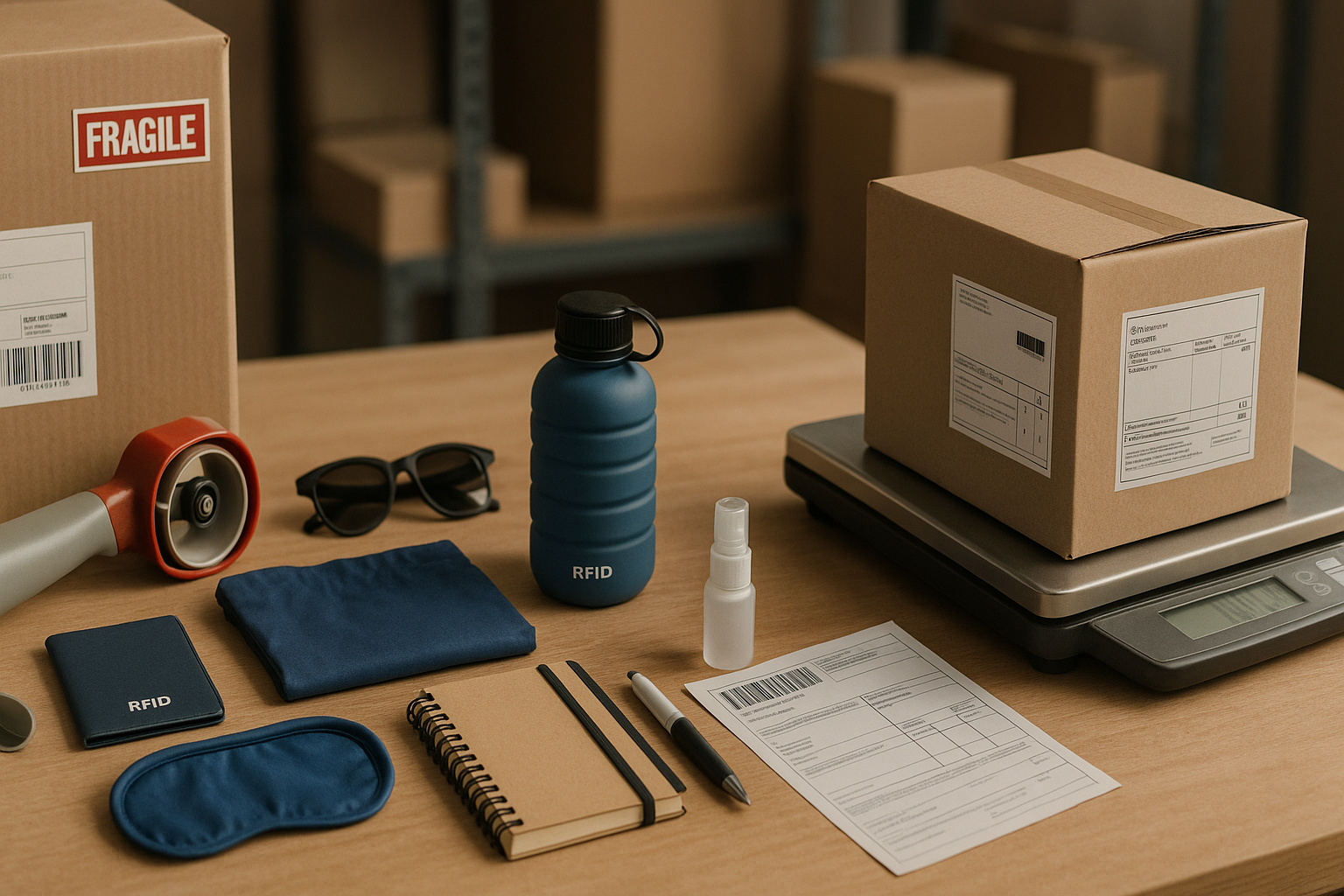
Pack light, protect smart: choose compact promos, use recycled padding, and label clearly to keep shipping costs low and deliveries damage-free.
Lightweight swag can still be expensive to ship if you ignore dimensional weight. For most carriers, the billable price for a package isn’t just its actual weight in pounds or kilogram, it’s the volume it occupies in a truck or plane. Smart trade show logistics means designing your box sizes, packaging, and material handling plan around dim weight pricing before a single carton leaves the warehouse.
What dimensional weight is—and why exhibitors pay it
Dimensional weight (often shortened to dim weight) is a density-based billing method used across freight transport, parcel courier networks, and UPS dimensional shipping/FedEx small-parcel lanes. Instead of billing by scale weight, carriers compute a theoretical weight using this core formula:
(Length × Width × Height) ÷ DIM factor = Dimensional Weight
Use the longest dimension on each side and round up to the next whole inch or cm.
Carriers publish the factor (also called a divisor). Lower factors create higher billable weights.
Your invoice compares actual scale weight to this computed number and bills the higher of the two. That’s why “light but bulky” trade show materials can trigger oversized charges during trade show shipping and drayage.
Quick carrier notes (use their calculators)
Policies change, so confirm with the official tools:
UPS dimensional weight: check the UPS DIM weight calculator / UPS dimensional weight calculator for current divisors and UPS volumetric weight guidance.
FedEx: use the FedEx cubic weight calculator or FedEx volume weight calculator and the “calculate DIM weight FedEx” help pages.
If your team ships via a broker, ask them to run samples through each dim weight calculator to compare cost by carrier and service level (air vs. ground transportation).
How to package travel-friendly promo so DIM works for you
The cheapest carton is the one that fits the product exactly. For compact, lightweight swag (notebooks, cable kits, collapsible cups), design box footprints that eliminate void space. Replace plastic air pillows with recycled paper that won’t balloon your volume. Consolidate SKUs into repeatable master sizes so pallets can be cubed efficiently, and material handling on the trade show booth floor is predictable.
Choose two master cartons (small/medium) that stay under common drayage breakpoints.
For fragile VIP gifts, create micro-inners that drop into the standard master so only that set gets extra protection. Your whole pallet shouldn’t pay the dim weight shipping penalty.
A worked example (so your team can sanity-check)
Say a flat-kit package measures 18" × 14" × 8". Using a divisor/factor of 139:
(18 × 14 × 8) ÷ 139 = 14.5 → rounds to 15 lb dimensional.
If the actual scale weight is 8 lb, the carrier bills 15 lb.
If you engineer the kit into a 16" × 12" × 6" box, the computed dimensional result becomes: (16 × 12 × 6) ÷ 139 = 8.3 → 9 lb. That one packaging change can cut the invoice almost in half.
Do the same math in metric for export (length, height, dimension in cm; billable kilogram). Your 3PL can help calculate dimensional weight in both systems.
Where trade show logistics adds surprise fees
Even perfect parcels can balloon once they hit the venue:
Crate vs. small-parcel: if you consolidate into a wood crate for a truck, show-site services price by drayage class and number of pieces. Fewer, denser pieces can lower your on-site bill.
Flat rate temptations: “flat” often hides baked-in dimensional assumptions. Run your real sizes through a calculator before saying yes.
March and Q4 surcharges: seasonal network volume changes, divisor rules, fuel, or accessorials. Re-check the factor and any “dim weight price” tables before you ship.
Checklist your ops lead can follow
Measure every finished carton (L×W×H) after kitting; round up, then compute dim with the current factor.
Compare to the actual scale weight; log both in your routing sheet.
Right-size: if dim dominates by 30%+, redesign the packaging or split to a smaller box.
Route: test rates with multiple carriers (ground truck, air, courier) using their official calculators—UPS DIM weight, calculate DIM weight FedEx, etc.
Stage: ship Day-1 essentials to the advance warehouse; hold low-risk overflow with your 3PL for just-in-time transport.
Label: show name, exhibitor name, booth, piece count (“Box 4 of 12”).
Close the loop: after the exhibition, capture billed DIM vs. actual for each lane and update your DIM weight pricing playbook.
Design choices that lower your bill and your footprint
Density wins: Flat kits, foldable drinkware, and paper-first sleeves raise density and reduce paid air.
Lightweight doesn’t mean “oversize”: keep one product dimension under the large-package threshold; a one-inch trim in length or height can drop you into a cheaper bracket.
Sustainability aligned: right-sized cartons cut fuel in the freight system and simplify customs inspection for cross-border transport.
What to ask your partners (verbatim prompts)
“Which dimension drives our current dim weight, and what factor are you using?”
“Run this through the UPS dim weight calculator and FedEx tools, send me the dim weight price deltas by service.”
“If we shift to a 16×12×6 master, what’s the new dimensional result in pounds and kilograms?”
“Can drayage drop if we collapse from 10 cartons to 6 denser pieces, and how does that affect material handling time at the trade show?”
The bottom line for exhibitors
Winning tradeshow logistics is equal parts engineering and arithmetic. If you calculate dimensional weight before you print a single belly band, you can choose carton sizes that protect product, speed transportation, and shrink your cost without compromising the attendee experience. That’s how business teams keep budgets on track while their promotional kits land on time, damage-free, and ready for the booth.
Frequently Asked Questions
What is the difference between actual weight and dimensional weight?
Actual weight refers to the physical weight of a package as measured on a scale, while dimensional weight is a calculated weight based on the package's dimensions. Carriers use dimensional weight to determine shipping costs, especially for lightweight but bulky items. The formula for calculating dimensional weight involves multiplying the package's length, width, and height, then dividing by a specific DIM factor. Understanding this difference is crucial for optimizing shipping costs and avoiding unexpected charges.
How can I reduce shipping costs for promotional products?
To reduce shipping costs for promotional products, focus on optimizing packaging. Use boxes that fit products snugly to minimize void space, and consider using lightweight materials. Consolidating items into fewer, denser packages can also help. Additionally, regularly compare shipping rates across different carriers and service levels, and utilize dimensional weight calculators to ensure you are not overpaying based on size rather than weight. Implementing these strategies can lead to significant savings.
What are common mistakes to avoid when shipping promotional products?
Common mistakes include neglecting to measure package dimensions accurately, failing to account for dimensional weight, and not comparing shipping options. Many shippers also overlook the importance of using the right packaging materials, which can lead to higher costs. Additionally, not planning for potential drayage fees at trade shows can result in unexpected expenses. By being aware of these pitfalls, you can better manage shipping logistics and costs.
How does seasonal demand affect shipping rates?
Seasonal demand can significantly impact shipping rates due to increased volume during peak times, such as holidays or major events. Carriers may adjust their DIM factors, fuel surcharges, and service availability based on demand fluctuations. It's essential to monitor these changes and plan shipments accordingly, as waiting until the last minute can lead to higher costs and limited options. Always check for updated pricing and policies during busy seasons to avoid surprises.
What role does sustainability play in shipping promotional products?
Sustainability is increasingly important in shipping promotional products, as companies seek to reduce their environmental impact. Using right-sized cartons, lightweight materials, and eco-friendly packaging can lower carbon footprints and shipping costs. Additionally, sustainable practices can enhance brand reputation and appeal to environmentally conscious consumers. By prioritizing sustainability in logistics, businesses can contribute to a greener supply chain while also optimizing their shipping strategies.
How can I ensure my promotional products arrive undamaged?
To ensure promotional products arrive undamaged, invest in quality packaging that provides adequate protection during transit. Use cushioning materials that absorb shocks and prevent movement within the box. Additionally, label packages clearly with handling instructions and ensure that fragile items are packed securely. Regularly review shipping methods and choose carriers known for their reliability and care in handling packages. Implementing these practices can significantly reduce the risk of damage during shipping.
What should I consider when choosing a shipping carrier?
When choosing a shipping carrier, consider factors such as cost, delivery speed, reliability, and customer service. Evaluate the carrier's policies on dimensional weight and any additional fees that may apply. It's also beneficial to check reviews and ratings from other businesses to gauge their performance. Additionally, consider the carrier's ability to handle your specific shipping needs, such as international shipping or special handling for fragile items. Making an informed choice can enhance your shipping experience.

