
The ROI of In-Booth Experience: Why Interactive Swag Outperforms Static Giveaways
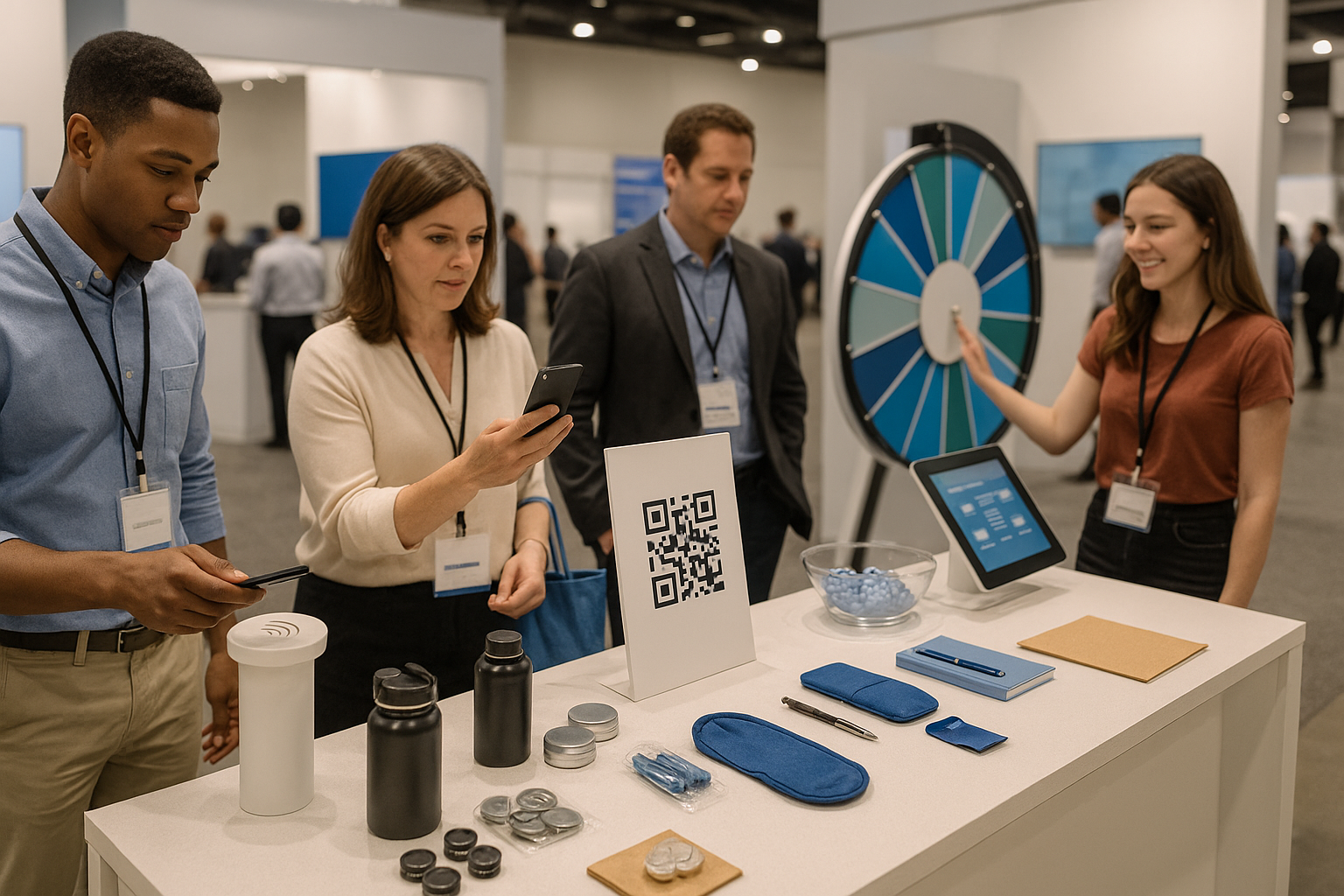
Hands-on demos plus QR capture beat static handouts—driving longer dwell time, higher-quality leads, and better ROI right on the show floor.
Trade show traffic is not the goal—pipeline is. If your booth still relies on static giveaways and a stack of brochures, you are paying premium rent on the trade show floor to run a self-serve merch table. Modern attendees expect participation, personalization, and proof that their time is well spent. That is why interactive swag experiential, trackable, and designed around a clear marketing strategy consistently outperforms passive handouts on every metric that matters: qualified leads, meeting conversion, brand awareness, and revenue attribution.
This pillar lays out a practical system you can copy: how to architect in-booth experiences, what to print and customize, where to place QR codes and UTM parameters, how to instrument Google Analytics and your CRM, and how to calculate a defensible return on investment for the CMO.
Static giveaways vs. interactive swag: what changes
Static giveaways treat swag as an expense line. You set out branded mugs or water bottles, people grab them, and you hope they remember you. Interactive swag treats the same product as a tool inside a designed experience. The item becomes the artifact of a conversation, a trigger for a micro-action, or a token that unlocks content after the show. In practice, that means: branded mugs or water bottles, people grab them, and you hope they remember you.
The attendee must do something simple (scan, answer, try, personalize) to receive the item.
The booth team captures or enriches data at that moment (email, role, pain point, timeline).
Every physical touchpoint routes to a landing page with tracking so you can follow behavior after the show.
Follow-up is automated, personalized, and timed to the attendee’s interest, not your calendar.
When you do this well, the giveaway ceases to be a cost of doing trade; it becomes a high-performance lead generation channel.
Design a micro experience with a single job
The most common mistake is trying to do everything at once. Choose one primary job for your experience:
Book meetings for sales.
Qualify and route leads to the right sequence.
Demonstrate a product feature that creates buying intent.
Everything in the booth, from the script to the swag, should reinforce that job. If your job is meetings, your item should help people remember to show up (e.g., a notebook with the meeting time printed inside the cover). If your job is demo adoption, your item should be the key that unlocks the demo content later (e.g., a tote with a QR inside that loads a saved workspace).
The four building blocks of interactive swag
1) An action worth taking
Ask attendees to do something that takes less than 30 seconds and feels fair: scan a dynamic QR code, tap an NFC tag, answer one question on a tablet form, or test a product in a quick challenge. The action should map to your ICP data fields (industry, role, timeline, use case) so your customer relationship management system has more than a badge scan.
2) A personalized artifact
Personalization turns a commodity into a memory. Think on-site printing or customization in under a minute: a first name printed on a notebook; a laser-engraved bottle with a short message; a patch heat-pressed to a tote; a postcard the attendee designs on a touch screen that prints while they chat. You do not need to personalize every item at the booth; reserve it for the counter tier to reward qualified conversations.
3) A digital bridge
Every physical surface needs a scannable path to a single, fast URL. Use short links with campaign UTM parameters that identify source (show), medium (booth), content (counter placard vs. tote interior), and creative (A/B). If you bundle tech, print the code on the packaging or an insert so the product stays clean. For shared devices, post privacy language near the scanner.
4) A follow-up that feels inevitable
Interactive swag works because it gives you context to reference in email marketing, SMS, or LinkedIn. “Here is the template you unlocked when you customized your notebook.” “Here is the case study you picked on the touch screen.” Schedule your first automation to arrive before the attendee boards the plane home; schedule the second for the Wednesday after the show when calendars stabilize. Route qualified leads to sales with the exact notes from the interaction.
Experience patterns you can deploy in weeks
The stamp card
Hand a slim card with three micro-stations: watch a 60-second product animation, answer a use-case question, and book a 15-minute virtual follow-up. Each station stamps the card (physical stamp or QR scan). Completing the card earns the personalized item. It is simple, game-like without being juvenile, and it paces traffic through the booth.
The build-your-kit counter
Instead of a generic tote, let visitors assemble a kit based on their role: notebook + pen for operators, cable + privacy cover for IT, collapsible cup for field teams. As they choose, the rep adds a short tag in the form (“Ops,” “IT,” “Field”). Your analytics dashboard later shows which roles dominated and which content converted.
The live print bar
Use heat transfer or screen printing for apparel and laser engraving for metal drinkware and pens. Offer two tasteful artwork options in your brand color palette and a small space for the visitor’s first name or initials. A rep captures name and email while the print runs (45–90 seconds), creating a natural conversation window to qualify without pressure.
Measurement: how to prove ROI without heroic spreadsheets
Tie every experience to a single campaign in your CRM. Then define five numbers you will report the same way after every show:
Scans: unique visitors who took the action (QR or form).
Conversations: visitors who spoke to a rep for at least one minute and were tagged.
Meetings set: on-site bookings or next-week slots.
Opportunities: pipeline created within 30 days of the show, attributed to the campaign.
Revenue: closed-won tied to the campaign within your normal sales cycle.
Finally, compute two ROI views:
Experience ROI = (Pipeline or Revenue from campaign – total experience cost) ÷ total experience cost.
Per-lead unit economics = total experience cost ÷ Conversations (or Meetings).
Experience cost includes the item, printing, counters, staffing, and equipment rental, not just the unit price of a tumbler.
Printing and customization that look like retail
Retail cues drive adoption. Use tone-on-tone inks, matte finishes, and micro marks so the product feels like a store purchase, not an ad. Move the pitch to the card or sleeve. For apparel, keep the chest mark small and align placements with current fashion. For drinkware, prefer laser or etch over wraps, especially for stainless steel. For notebooks, use deboss or a refined foil rather than heavy solid ink.
If your brand mandates full color, consider a discrete badge, patch, or woven label. Attendees will carry subtle branding into offices where real brand awareness happens.
Gamification without gimmicks
Simple performance cues increase customer engagement without feeling like a carnival:
A timer on the screen that shows “45 seconds left” to finish an activity.
A progress bar on the stamp card.
A visible counter that unlocks a donation (e.g., “When we reach 1,000 scans, we fund 100 classroom kits”).
Each cue creates momentum and social proof while your reps keep conversations human.
Staffing the booth like a high-end retail floor
Your trade show booth is a pop-up store. Treat staffing like retail:
Assign one greeter who triages traffic and starts the experience.
Keep one specialist per station to answer real product questions.
Reserve one closer who books meetings.
Train on scripts that fit the experience (“Choose your kit” is different from “Spin the wheel”).
Schedule 15-minute reset breaks to restock kits, wipe counters, and reconcile counts. A tidy booth signals quality.
Budget: spend where the return is highest
The aisle tier should be light and inexpensive; the counter tier gets your customization; the VIP tier gets a hero piece only when a meeting is booked. Because interactive swag improves conversion, you will usually see a higher ROI by shifting budget from a fourth SKU to the print bar.
A realistic starter mix for mid-market B2B:
Aisle: recycled-paper notebook or braided cable with a tasteful mark.
Counter: build-your-kit (notebook + pen + privacy cover or cup + straw).
VIP: laser-engraved bottle or fold-flat wireless pad after a scheduled demo.
Data plumbing: what to instrument before the show
QR codes: one per surface (placard, tote interior, counter tent). Each must carry unique UTM parameters.
Landing pages: three loads max, no dead ends, form prefilled if the badge scan already captured email.
CRM fields: show name, booth source, role tag, use case, and meeting time.
Automation: a “thanks + resource” email that references the exact experience, then a nudge two days later tied to the role.
Dashboard: a simple view showing scans → conversations → meetings → opportunities by day and by station so you can adjust staffing live.
Sustainability that makes operations easier
Interactive programs are naturally environmentally friendly when you keep formats flat and packaging paper-first. Personalization discourages abandonment. Right-sized cartons reduce freight and drayage. If you donate remaining stock, your recap can report waste avoided and the number of items reused, useful for corporate social responsibility reporting without performative language.
Risk management: avoid the friction that kills conversion
Skip aerosols and loose batteries at the aisle.
Keep personalization under 90 seconds per person to prevent lines.
Provide an analog path (short URL) in case a device camera fails.
Have a backup printer and spare consumables.
Document the plan on one page in your runbook so any rep can step into any station.
A one-page plan you can paste into your runbook
Goal: 120 qualified conversations, 40 meetings set, 12 opportunities within 30 days.Experience: Build-Your-Kit Counter.Aisle tier: A5 notebook (debossed).Counter tier: Attendee chooses two of four: metal pen, privacy cover, cable trio, collapsible cup.VIP: Laser-engraved bottle after meeting booked.Tracking: Unique QR on counter tent, tote interior, and kit card; UTM by surface; campaign in CRM.Automation: Instant resource email; Wednesday follow-up; SDR call on booked meetings list.Metrics to report: scans, conversations, meetings, opportunities, revenue, cost per conversation, and per meeting.
Straight answers teams ask
Do interactive stations slow down the booth?
Only if you overcomplicate them, keep any action under 30 seconds, and staff for flow. The minute you free is the minute a rep uses to qualify.
What if we cannot print on site?
Personalize the insert instead: a name printed on a card that slides into the notebook pocket or a luggage tag printed while the attendee chats with a closer. Or capture initials for post-event engraving and ship a “thank you” piece within a week.
How much more does this cost than static giveaways?
Unit cost is similar; your investment shifts to a printer and staffing. In most programs, the lift in meetings and opportunities offsets the equipment rental on the first day.
How do we prevent people from grabbing and running?
There is nothing on the aisle to grab. Items live behind the counter and are handed over by a rep after the micro-action is complete.
How do we prove the impact to finance?
Attribute scans and meetings with UTM + campaign fields. Report pipeline formed within 30 days and compare to last year’s static program. Present both ROI and unit economics so finance sees efficiency, not just totals.
Bring it home
Interactive swag is not a gimmick; it is experience design applied to trade show marketing. Choose a single job, build a micro-action, personalize the artifact, connect it to digital, and automate follow-up. Instrument every surface, measure the funnel, and report ROI in the same language your finance team uses. You will leave the show with fewer leftover boxes, clearer data, and a pipeline story that justifies the next event because the giveaway finally did the work it was supposed to do.

