
Gamification Ideas for Trade Show Swag Booths
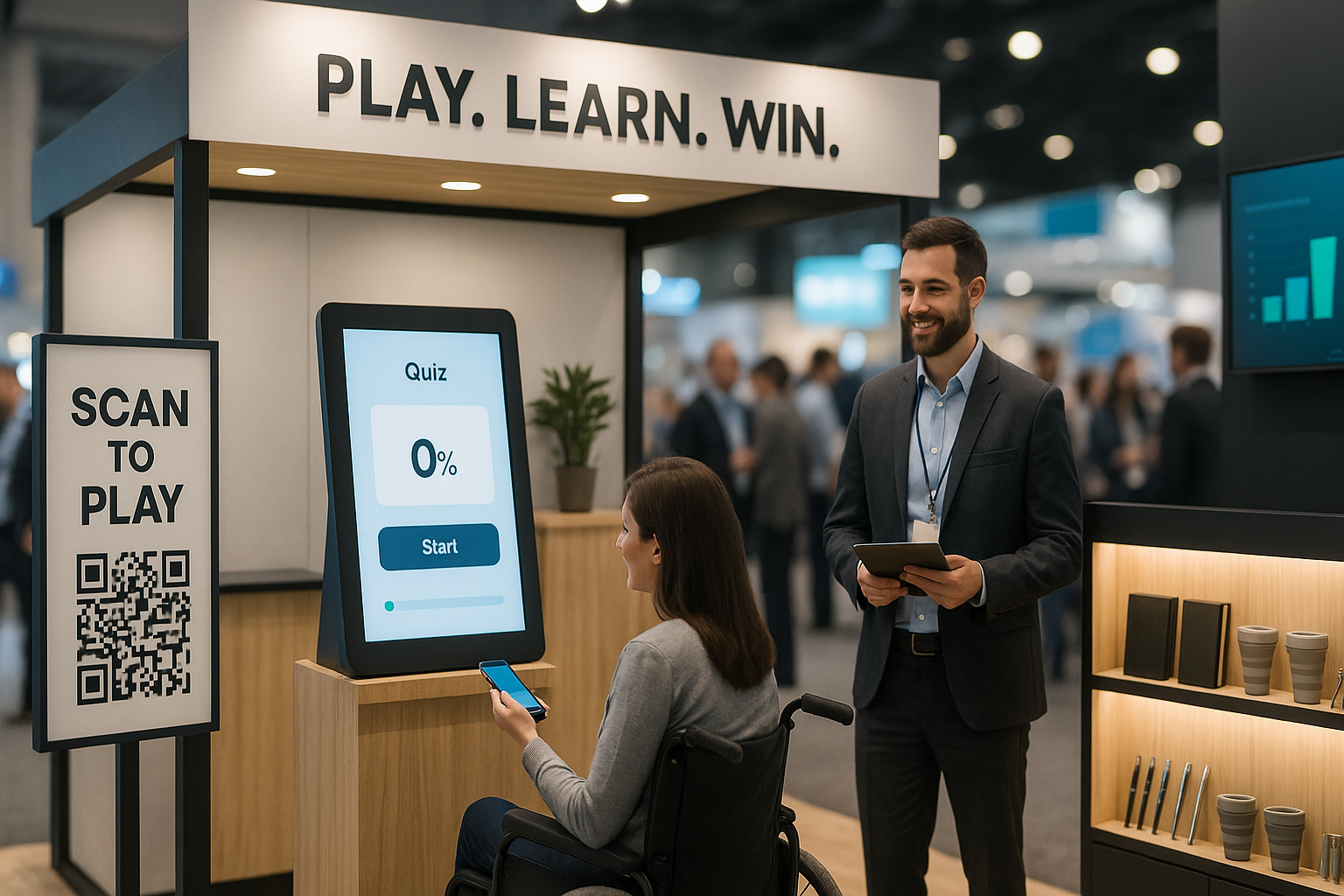
A focused gamification booth: scan → quiz → instant feedback → prize, all tracked to analytics—accessible layout, clear signage, and staff support turn fun into qualified leads.
Great gamification is not a toy; it is a lead generation engine disguised as entertainment. On a crowded trade show floor, you have seconds to win attention, spark conversation, and capture data that your digital marketing stack can use. The right gamification strategy blends psychology, simple technology, and tasteful design to move your target audience from passerby to qualified lead and to prove return on investment with clean analytics.
Start with one business goal and architect the experience
Decide what the game must do: fill the mailing list, book meetings, or teach a product concept. With a single goal, you can design the trade booth flow, signage, and touchpoints to support it. Keep the route intuitive, clear lighting, visible progress cues, and an open space that manages traffic flow for people using a smartphone, wheelchair, stroller, or cane. Accessibility is a growth lever.
Craft a simple loop: action → feedback → reward → next step
The loop should take under two minutes:
Action: scan a QR code, tap a touchscreen, or step into a short simulation.
Feedback: immediate on-screen result, haptic buzz, or light animation via projection mapping or sensors.
Reward: a tasteful prize (e.g., gift card, engraved pen) or a personalized artifact.
Next step: auto-load a landing page with lead capture and a meeting scheduler.
Add UTM tags to every code so data collection ties to the exact trade show display and booth idea that drove engagement.
Mechanics that convert without clutter
1) Trivia + Quiz that teach while qualifying
Short trivia or quiz rounds reveal role, use case, and urgency. Ask one behavior question (“What’s the biggest barrier to adoption?”) and route answers to the right follow-up sequence. On completion, a printer produces a personalized card or small badge with your logo and a scannable link. This builds brand awareness and brand loyalty without an overwhelming budget.
2) Scavenger hunt with modern signals
Design a three-stop scavenger hunt: a QR hidden in your demo, a clue on a banner, and a final scan at the photo booth. Each stop adds a point on a touchscreen progress bar; finishing triggers a limited prize or raffle entry. Use a show-wide hashtag to extend social media marketing attendees who post their selfie add one extra entry. You gain reach and measurable visibility.
3) AR/VR that feels like a decision tool
Augmented reality overlays specs on physical products; virtual reality offers a 60-second guided simulation. Keep scenes short and purposeful. Tap to choose a feature, then see predicted outcomes. The “aha” moments turn your team into thought leaders rather than game hosts. For heavier traffic, swap full headsets for an AR smartphone view and a countertop touchscreen.
4) The micro “escape room”
Instead of a 15-minute puzzle, create a 90-second cooperative challenge. Three booth visitors match icons on a touchscreen, trigger a light via sensor, and “unlock” the swag drawer. It blends gameplay, storytelling, and team behavior while giving your reps a natural entry point to ask discovery questions. The cooperative dynamic lifts customer memory and makes a stronger case for event ROI.
5) Nostalgia, not noise
An arcade game skin, think skee-ball counter or a digital slot machine, can work if the outcome maps to business value. Each play reveals a case study, pricing calculator, or a content marketing asset. The “win” is knowledge plus a small prize; the rep guides the next step. Keep security in mind: no badge data on shared leaderboards, and sanitize surfaces to support sustainability and attendee comfort.
Make rewards feel like retail—and tie them to data
Prizes should be compact and useful: notebooks with on-site name printing, metal pens with laser etch, privacy covers, or collapsible cups. To claim, the visitor confirms name and email on your software form fast, consent-forward management of the mailing list. Offer a few corporate events-friendly alternatives (quiet kits, sensory tools) for attendees who prefer low-stimulus items.
Instrumentation: prove the impact like an expert
Tag every surface with unique QR codes and source parameters. Your analytics should show:
Scans → form completes → meetings → sales opportunities → revenue.
Which trade show games (quiz, scavenger, AR) produced the highest qualified rate?
Average time in experience and dwell by touchpoint.
Share a one-page report with event management and leadership highlighting investment vs outcomes. That is how gamification moves from “fun” to a predictable tool in trade show marketing.
Operations that keep lines short
Rehearse until any first-time visitor can finish in under two minutes. Place reset tables behind the counter for fast restaging. Train a three-role crew: greeter, specialist, closer and script conversation prompts. Maintain organization with labeled bins and a simple booth runbook so anyone can step in. Keep a sustainability checklist: paper-first tickets, reusable fixtures, low-power lighting, and recycling for packaging.
Straight answers (no FAQ label)
How do we stop prize-only seekers?
Keep prizes behind the counter; the lead capture moment is the handoff. No game completion, no prize.
Do AR/VR and AI overcomplicate?
Only if they replace clarity. Use artificial intelligence to route answers or generate a tailored recap, not to run the whole booth. Use AR for overlays, not 10-minute tours.
What if the Wi-Fi drops?
Print short URLs and offline claim cards. Sync data when back online so event marketing continues without gaps.
How much should we spend?
Allocate more to staffing and measurement than props. A simple quiz with strong design outperforms a costly build with a weak strategy.
The takeaway
Gamification that respects humans’ clear accessibility, short loops, meaningful information, and tasteful rewards drives better engagement, cleaner lead data, and higher event ROI. Start with one goal, choose a mechanic that fits your audience, wire every digital surface for tracking, and let your team do what machines cannot: listen, teach, and build trust in your brand.

