
Step-by-Step: How Overseas Brands Can Order Promo Products Locally in Las Vegas
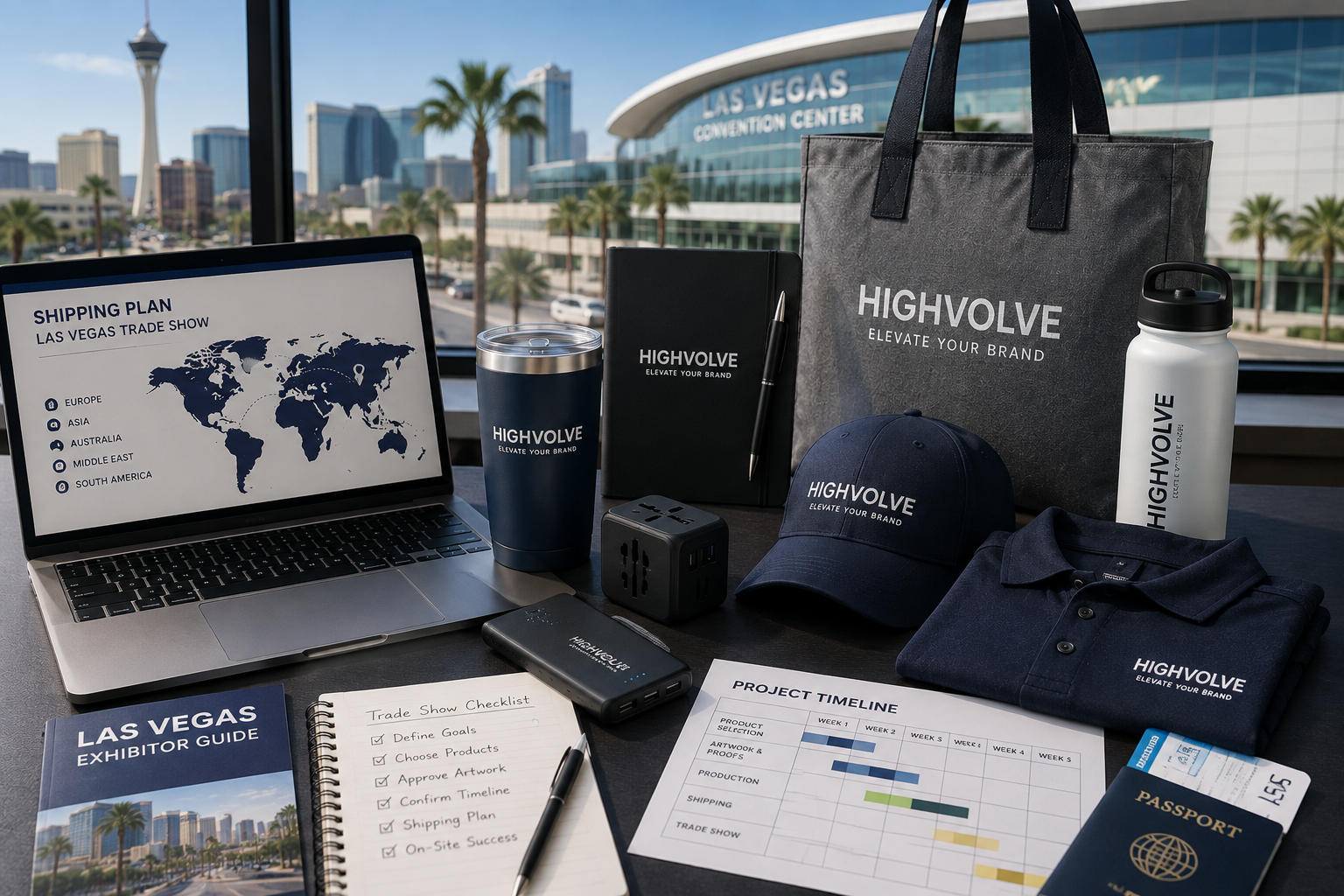
Order locally, fulfill in Vegas: place the order with a US vendor, verify specs, and schedule on-site pickup for stress-free exhibiting.
Planning a Las Vegas trade show from overseas can feel complicated.
Your team may be managing flights, booth logistics, exhibitor deadlines, artwork, product approvals, customs questions, shipping instructions, and last-minute changes from a different time zone. Add promotional products into the mix, and the details can quickly become stressful.
The good news is that overseas brands do not always need to ship every giveaway, apparel item, or client gift from their home country.
Working with a U.S.-based promotional products partner can help you source branded merchandise for your Las Vegas event, coordinate artwork approvals, manage production timelines through supplier networks, and plan shipping to the right destination before the show.
HighVolve is based in Henderson, Nevada, near Las Vegas. We help overseas and out-of-state companies plan, source, and coordinate promotional products, branded apparel, corporate gifts, company stores, and event merchandise for U.S. trade shows.
To be clear: HighVolve does not offer local customer pickup, does not manufacture promotional products in-house, and does not claim to operate a Las Vegas warehouse. Our role is to help clients choose the right products, prepare artwork, coordinate with trusted suppliers and production partners, and plan shipping based on the event timeline.
If you are exhibiting in Las Vegas and want to avoid shipping everything internationally, this guide explains how the process works.
Why Overseas Exhibitors Order Promotional Products in the U.S.
International exhibitors often assume they need to produce all of their branded merchandise in their home country, pack it with booth materials, and ship everything to Las Vegas.
Sometimes that makes sense.
But for many events, ordering promotional products through a U.S.-based partner can be more practical.
A U.S.-based promo partner may help you:
Avoid shipping every giveaway internationally
Reduce customs complexity for simple promotional products
Source products already available in the U.S.
Coordinate decoration and production through U.S. supplier networks
Review artwork before production
Plan shipping to a hotel, show site, office, or other approved destination
Choose products that are practical for Las Vegas attendees
Build a more realistic event merchandise timeline
This can be especially helpful when your team is exhibiting at major Las Vegas events such as CES, SEMA, NAB Show, MAGIC, ASD Market Week, PACK EXPO, G2E, or other large conferences.
For more event-specific planning, read our guide to Las Vegas promotional products for trade shows.
Step 1: Confirm Your Event Details
Before choosing products, gather the event information your promo partner will need.
At minimum, confirm:
Event name
Event dates
Venue
Booth number, if available
Exhibitor move-in dates
Deadline for materials to arrive
Ship-to address
Receiving contact
Any hotel, venue, or show contractor instructions
Whether products are for booth traffic, VIP meetings, employees, or post-show follow-up
This information matters because the best shipping plan depends on where the products need to go and who will receive them.
HighVolve does not offer local customer pickup, so the delivery plan should be built around shipping to an approved destination. That may be a hotel, show site, client office, event contractor, fulfillment partner, or another approved receiving location depending on the project.
Always confirm receiving requirements before the order is placed.
Step 2: Decide What the Products Need to Accomplish
Do not start with the product.
Start with the goal.
Are you trying to:
Drive booth traffic?
Start conversations?
Thank existing clients?
Book follow-up meetings?
Support a product launch?
Outfit booth staff?
Give VIP gifts to scheduled meetings?
Send post-show gifts to qualified leads?
Different goals call for different merchandise.
For general booth traffic, practical lower-cost items may work best. These could include pens, lip balm, mints, tote bags, charging cables, notebooks, badge accessories, or other easy-to-distribute products.
For qualified leads, consider mid-range items such as insulated drinkware, tech organizers, wireless chargers, premium notebooks, travel pouches, or branded apparel.
For VIP prospects, scheduled meetings, or existing customers, premium gifts may be more appropriate. These could include curated gift boxes, executive backpacks, premium drinkware sets, gourmet gifts, or branded kits.
The strongest event merch strategy usually includes more than one product tier.
Step 3: Choose Products That Make Sense for Las Vegas
Las Vegas trade shows are different from local office events.
Attendees are often walking long distances, carrying materials through crowded exhibit halls, moving between hotels, and flying home with limited luggage space.
That means your giveaways should be useful, packable, and easy to keep.
Strong product categories for Las Vegas trade shows include:
Drinkware
Tote bags
Travel pouches
Charging cables
Power banks
Notebooks
Pens
Lip balm
Sunscreen
Cooling towels
Tech organizers
Badge holders
Branded apparel
Compact VIP gifts
Avoid products that are overly bulky, fragile, heavy, or difficult for attendees to pack.
A product may look impressive in a catalog but still fail at the event if attendees do not want to carry it home.
For more ideas, see our guide to best trade show giveaways.
Step 4: Prepare Your Artwork Early
Artwork is one of the most common reasons promotional product orders slow down.
A logo file that works on a website may not automatically work for embroidery, laser engraving, screen printing, pad printing, debossing, or full-color decoration.
Before production can begin, your promo partner may need:
Vector logo files
Brand colors
Font guidance
Placement preferences
Approved logo versions
Artwork notes
Any event-specific messaging
Final spelling and contact information
If you are overseas, build in extra time for artwork review and approval across time zones.
HighVolve can help review artwork and coordinate proofs with suppliers and production partners before production. We can also support design services when artwork needs cleanup, layout support, mockups, or formatting.
Step 5: Review Proofs Carefully
A proof shows how your logo or design is expected to appear on the product.
This is your opportunity to check:
Logo placement
Logo size
Colors
Spelling
Product color
Decoration method
Orientation
Imprint area
Any personalization details
Do not rush this step.
Once a proof is approved, production usually begins based on that approval. Changes after approval may not be possible, or they may create delays and additional costs.
For overseas teams, it helps to assign one person who has authority to approve proofs quickly. Too many reviewers across multiple time zones can slow the project down.
Step 6: Build a Realistic Production Timeline
Promotional products require more than the shipping time shown on a carrier website.
A realistic timeline may include:
Product sourcing
Inventory confirmation
Quote approval
Artwork preparation
Proof creation
Proof approval
Production
Packing
Shipping
Receiving
Internal distribution before the event
Some products can move quickly. Others require more time, especially apparel, premium gifts, custom packaging, kitting, large quantities, or products with complex decoration.
Rush options may be available, but they often limit your choices.
HighVolve helps clients understand what is realistic based on product availability, supplier timelines, artwork readiness, quantity, decoration method, and delivery destination.
We will not promise that every rush request can be solved. We would rather give you a realistic plan than create a problem the week of the show.
Step 7: Plan Shipping Before Production Starts
Shipping should never be an afterthought.
For Las Vegas trade shows, products may need to ship to:
A hotel
A show site
A client office
A team member
A show contractor
A supplier-managed destination
A fulfillment partner
Multiple recipients after the event
Each option has different considerations.
Hotels may have receiving fees, labeling rules, storage limits, and internal delivery procedures. Show sites may require booth numbers, delivery windows, material handling instructions, or contractor-specific labels. Shipping to a team member may give more control, but that person must be available to receive and transport the order.
HighVolve can help think through shipping options, but the client should always confirm venue, hotel, or show contractor requirements directly when needed.
We do not recommend assuming that boxes can simply arrive at a hotel or booth without instructions.
Step 8: Understand What HighVolve Coordinates
HighVolve helps overseas exhibitors coordinate the branded merchandise side of their Las Vegas event.
That may include:
Product recommendations
Promotional product sourcing
Branded apparel options
Corporate gift planning
Artwork review
Proof coordination
Supplier coordination
Production timeline management
Packaging recommendations
Kitting discussions when appropriate
Shipping planning
Post-show gifting strategy
Depending on the project, kitting, packaging, fulfillment, and shipping may be handled through suppliers, production partners, fulfillment partners, or other approved resources.
HighVolve does not own a Las Vegas warehouse. We do not offer local customer pickup. We do not manufacture products in-house.
Our value is in helping clients choose the right products, avoid common planning mistakes, coordinate with the right resources, and keep the project moving.
Step 9: Consider Booth Apparel
Overseas exhibitors often focus on giveaways and forget booth apparel until the last minute.
That can create problems.
Booth staff apparel helps your team look polished, coordinated, and easy to identify. Depending on the event and brand, options may include:
Branded T-shirts
Performance polos
Quarter-zips
Jackets
Hats
Lanyards
Name badges
Team kits
For professional trade shows, apparel should be comfortable enough for long days but polished enough for client conversations.
HighVolve can help source branded apparel and coordinate decoration through appropriate production partners.
For more guidance, read our article on branded apparel for trade show booth teams.
Step 10: Use Post-Show Gifts Strategically
Not every promotional product needs to be handed out at the booth.
For overseas exhibitors, post-show gifting can sometimes be easier and more effective than trying to bring every premium gift to the show floor.
Post-show gifts can be used for:
Qualified leads
Existing customers
Scheduled meetings
Hosted buyers
Press contacts
Strategic partners
Sales follow-up
A post-show gift can include a handwritten-style note, product information, a QR code, meeting link, case study, or follow-up offer.
This approach can reduce booth storage needs while making the gift feel more personal.
HighVolve can help plan corporate gifts and follow-up merchandise that supports your sales process after the event.
What Overseas Exhibitors Should Avoid
Do Not Wait Until the Last Minute
International teams need extra time for approvals, time zones, artwork review, payment processing, and shipping decisions.
Start early whenever possible.
Do Not Assume Local Pickup Is Available
HighVolve does not offer local customer pickup. Plan for shipping to an approved receiving destination.
Do Not Assume Everything Is Produced in Las Vegas
Many promotional products are sourced and decorated through national supplier and production networks. The best production path depends on the product, decoration method, quantity, inventory, and timeline.
Do Not Ship Without Confirming Receiving Instructions
Hotels, venues, and show contractors may have specific receiving rules. Confirm details before your order ships.
Do Not Choose Products Only by Price
The cheapest product may not represent your brand well. Focus on usefulness, quality, audience fit, and whether the item will actually be kept.
Do Not Give Premium Gifts to Everyone
Use tiers. Save premium merchandise for high-value contacts, scheduled meetings, existing customers, or post-show follow-up.
Recommended Product Categories for Overseas Exhibitors
Travel-Friendly Giveaways
These are useful for attendees who are walking the show floor and flying home:
Tote bags
Collapsible water bottles
Lip balm
Charging cables
Travel pouches
Luggage tags
Notebooks
Pens
Tech Giveaways
These work well for business travelers and technology-heavy audiences:
Power banks
Wireless chargers
Phone stands
Tech organizers
Webcam covers
Bluetooth trackers
Booth Team Apparel
These help your staff look coordinated:
Polos
T-shirts
Quarter-zips
Jackets
Hats
Lanyards
VIP Gifts
These are better for scheduled meetings or post-show follow-up:
Premium drinkware
Executive backpacks
Curated gift boxes
Notebook gift sets
Gourmet gifts
Premium tech gifts
Wellness Items
These are useful for long show days, especially in Las Vegas:
Lip balm
Sunscreen
Cooling towels
Hand sanitizer
First aid kits
Reusable bottles
How HighVolve Helps Overseas Brands
HighVolve helps overseas brands simplify the promotional product process for U.S. trade shows.
We can help you:
Choose products that fit your audience and event
Source promotional products through trusted supplier networks
Coordinate branded apparel
Review artwork and product proofs
Plan realistic production timelines
Recommend shipping approaches
Build VIP gift ideas
Create post-show follow-up gifts
Coordinate company store programs when needed
For ongoing employee, customer, or sales merch programs, HighVolve can also support company stores.
What HighVolve Does Not Do
HighVolve does not provide local customer pickup.
HighVolve does not manufacture promotional products in-house.
HighVolve does not claim to own or operate a Las Vegas warehouse.
HighVolve does not personally print, embroider, engrave, heat-press, store, or replenish every order.
HighVolve does not provide official show services such as material handling, rigging, electrical, booth installation, union labor, or venue-managed freight.
For official event logistics, always follow your exhibitor manual and venue or show contractor instructions.
HighVolve focuses on branded merchandise: promotional products, apparel, corporate gifts, kits, packaging recommendations, design support, and related coordination.
Frequently Asked Questions
Can overseas companies order promotional products for a Las Vegas trade show?
Yes. Overseas companies can work with a U.S.-based promotional products partner to source branded merchandise for Las Vegas trade shows. This can reduce the need to ship every giveaway internationally.
Does HighVolve offer local pickup in Las Vegas?
No. HighVolve does not offer local customer pickup. Orders should be planned around shipping to an approved receiving destination.
Does HighVolve manufacture promotional products in-house?
No. HighVolve does not manufacture promotional products in-house. We coordinate sourcing and decoration through trusted suppliers and production partners.
Can HighVolve help ship promotional products to a Las Vegas hotel or venue?
HighVolve can help plan shipping, but the receiving destination must be confirmed before the order ships. Hotels, venues, and show contractors may have specific requirements, labels, fees, or delivery procedures.
Can HighVolve help with rush orders for overseas exhibitors?
Sometimes. Rush options depend on product availability, artwork readiness, decoration method, quantity, production schedule, and shipping destination. Rush orders may limit product choices or increase costs.
What promotional products work best for overseas exhibitors?
Travel-friendly products usually work best. Strong options include tote bags, collapsible water bottles, lip balm, charging cables, notebooks, pens, travel pouches, tech organizers, and compact premium gifts.
Can HighVolve help with booth apparel?
Yes. HighVolve can help source branded apparel for booth teams, including T-shirts, polos, quarter-zips, jackets, hats, and other options depending on timeline and budget.
Can HighVolve help with post-show gifts?
Yes. HighVolve can help plan post-show gifts for qualified leads, clients, and VIP prospects. This can be a smart option when you do not want to bring premium gifts to the booth.
Plan Las Vegas Trade Show Merch from Overseas
Ordering promotional products from overseas does not have to mean shipping every item internationally or guessing your way through a U.S. supplier process.
HighVolve helps overseas brands plan promotional products, branded apparel, corporate gifts, and event merchandise for Las Vegas trade shows.
We help you choose products that fit your audience, coordinate artwork and proofs, plan realistic production timelines, and think through shipping before the event.
Whether you need promotional products, branded apparel, corporate gifts, company stores, or design services, HighVolve can help you build a practical event merch plan.
Ready to start planning? Schedule a call with HighVolve and tell us your event date, audience, quantity, budget, artwork status, and delivery needs.

